Banner
Banner

Sign Up for Brew Your Own’s Free E-Newsletter

Email
Get a free trial issue of WineMaker.
Banner
Indoor Brewery
Author Colin Kaminski
Issue November 2002


I feel a little guilty in the winter, when I’m brewing inside the microbrewery and it’s a chilly 60 degrees here in California. Meanwhile, my brethren in the Northeast are trying to make a 5-gallon batch outside in sub-freezing weather. In California, brewing indoors is a convenience. In other places, it’s a necessity.

Building an indoor brewery is a dream for many homebrewers. It’s also a big challenge, and in this article I hope I can teach you enough to understand some of the most serious problems. It’s beyond the scope of this article to give you all of the necessary skills to engineer an indoor brewery yourself. It is not the things you understand that will get you in trouble, but the things that didn’t even cross your mind. When I say I recommend something, I really mean it. Cutting corners is risky.

If you undertake building a brewery indoors, you must first consult an expert (such as a licensed gas engineer) and get him to sign off on your plans. This may not be as hard as it sounds. Simply make a detailed sketch and an engineer will study it, make suggestions and sign the bottom. The usual fee in California for this is $100 to $150 per hour, and if there are no changes, it can be done in under two hours. This may vary from state to state, but this approach can work if you are an experienced do-it-yourselfer who has worked with gas before.

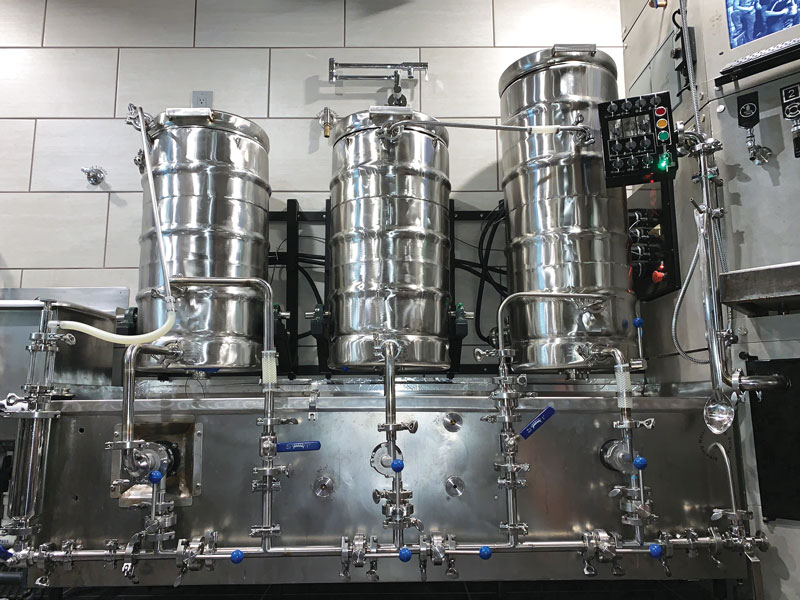
The brewing system at Downtown Joe’s in Napa, California, where author Colin Kaminski works. It’s an enclosed system with a combustion chamber.

If you don’t have the skills, don’t even think about building a brewery yourself. Hire contractors and let the pros do the job. You should also talk to the local gas company about the building codes in your state. In some states, for example, the gas company won’t hook up your system unless it was built by a licensed propane-gas installer.

If you are ambitious, you can do your own calculations. Start at the gas supply and finish at the top of the flue. At every place in between, specify the material and size used. Then cross-reference each calculation to the “Gas Engineers Handbook” with a page number or table number. If you used any correction factors, list the correction factors and the place in the handbook where you found it. This is a lot of work, but will save money in the long run and give you the experience and satisfaction of designing a gas system from scratch. Once again, do not install a gas system without having a licensed engineer sign the plan or consulting a gas company! I have designed many gas systems and I would never consider running a gas system inside without an engineer’s approval.


You should be able to find a copy of the “Gas Engineers Handbook” at the local library. A good example of a problem that’s covered by this text would be joining a flue from one appliance with the flue to another, or connecting the flues from three burners in your brewhouse. An hour with a good text will help avoid a potentially dangerous situation.

A homebrew system that’ll be fired by propane piped in from outside,
with an exhaust hood and fan.


I have chosen to talk only about gas-fired breweries because that is where the danger is most acute. If you undertake an electric-fired brewery make sure you know an electrician very well, as making high-current connections takes much care and the risks of fire and electrocution are great.

Seven things to consider

There are many things to think about when designing a brewery. Here are the key things that will be of interest to you and your contractor: effluent, heat, gas supply, exhaust venting, make-up air, water vapor and carbon-monoxide detection.

Effluent

If you have the space and resources it would be a great idea to make a sloped floor and install a drain. Then you can just hose things down. I have found a slope of 0.125” per foot works adequately. If the floor is small a slope of 0.25” per foot can be used for quicker runoff. If you are in a basement, this could be a problem and may involve a pump. Still, it is a convenience I would highly recommend.

Carefully consider the things you may wish to put in your drain. Most drains are plumbed with black ABS plastic pipe. If you sterilize with lots of hot water then you can easily melt this pipe. CPVC is a beige-colored PVC designed for use with hot water and is cheaper than cast iron, but cast iron would be best.

If you are not putting in a floor drain then you will have to install a sink large enough to clean up your kettles and fermenters. If this is in your basement then a pump may be required to get your effluent up to the sewer level. Otherwise you will have to take things outside to clean.

Since the batch size for a home brewery is small, effluent is a fairly simple problem to solve. For larger breweries it is often the most important consideration when choosing a building site.

Heat

To achieve a vigorous boil, your burners must generate a considerable amount of heat. It’s important to put the heat where you need it, while protecting surfaces that are flammable.

Much of the heat will be carried away by the air. The rest of the heat is radiated as infrared light. This infrared heat will radiate from the burner and kettles. Again, it is very important to protect anything flammable from this source of heat. Infrared heat (like visible light) dissipates with the square of the distance, so you only need to protect the surfaces that are near to the burners, like the back wall and the floor. Many homebrewers use 400,000 to 600,000 total BTUs in their indoor breweries. For this amount of heat and an enclosed system (see below), most reference books recommend a distance of 12 to 18 inches between the burners and anything combustible. You should allow even more distance if your system has open flames. These are minimum recommendations; check with an expert.

Often people use WonderBoard and then cover it with a fire-proof material. WonderBoard is a concrete board that comes in thicknesses of one-quarter inch and one-half inch. WonderBoard is not a final surface, so you must install tile or another fire-proof and water-proof substance on top of it. The construction is similar to what is used behind a wood-burning stove. There are other choices available and each of them requires the gas burner to be spaced a certain distance from the surface.

You may also want to consider the ceiling. While we will make every effort to vent the steam from the kettle, there still can be a considerable amount of steam condensing on your ceiling. If you have sheetrock with flat latex paint, you could have some long-term water damage. If nothing else, I would use gloss paint as it is better suited to water exposure and it is easier to clean. A more ambitious solution is to attach a pipe to the lid on the kettle and run the pipe to the outside. If you choose this method it is important to make sure the condensate cannot drip back into the boil, because the steam carries off undesirable flavors.

Gas supply

You will need to get gas to your brewhouse. There are two options: pipe in natural gas from the city supply or pipe in propane from the main tank outside your house. Do not use a refillable propane tank in an indoor brewery: It is against building code and dangerous. This is very important! The vent hole can and does release propane if the diaphragm ruptures.

When bringing gas inside, make sure you have a large-enough pipe to carry your gas. In any run of pipe there is a pressure drop due to friction of the gas against the walls of the pipe. It is common to design a  gas-delivery system to allow not more than 0.3 to 0.5” water column (0..011 to 0.018 pounds per square inch) of pressure drop. Water column is a measure used for very low pressures, like gas-line pressure, and is the standard when dealing with natural gas. A 0.5-inch Schedule 40 pipe will not carry enough gas to burn three 200,000 BTU burners. For complex runs the number and type of fittings is also important. In the “Gas Engineers Handbook” there are tables that give you correction factors for fittings and pipe runs. When in doubt, use the next-largest pipe size.

For an example of the kind of math involved, to run a single 200,000-BTU natural gas burner with a run of 10 feet, you would need 0.75” diameter pipe. For a 20-foot run you would need 1” diameter pipe. You also need to add a calculation for the added friction of the fittings.

In order to run a pipe for propane, you would need 0.5” pipe for 10 feet,  0.75” pipe for 20 feet and 1” pipe for 100 feet in order to supply a 200,000-BTU burner. If you are running three 200,000-BTU burners, then you would need 1” pipe for a 10-foot run and 1.25” for a 100-foot run. This is not to be considered a recommendation, because your city codes and installation will be different. A plumber will know about proper leak checking and hanging methods. Unless you have been trained as a plumber, I don’t recommend you install this yourself.

These numbers are given so you can get a feel for the size changes and are not intended to be prescriptive. Look up your system in a plumbing text to calculate the needs for your system, then hire a plumber to check your work and install it. With multiple appliances hooked up to a gas system, you start at the appliance furthest from the meter and work backwards to calculate the total gas demand on each section of pipe. In this way you can calculate a tapered pipe system that will supply all of your appliances.

This is a good place to mention that propane gas is heavier than air and can pool in a basement. Pools of explosive propane gas are very dangerous. Building codes may prohibit the use of propane in any room with a portion below grade to prevent explosions. If water cannot run to the outside, then propane won’t either. Also, water can collect in basements and can put out pilot lights, causing gas to leak from the pilot. I would shut off any pilot lights when not in use or install a pilot sensor to shut off the gas if the pilot light goes out. Most cities have a code that sets the minimum height a pilot light can be above the floor to avoid flood waters from putting them out.

Exhaust venting

There are two main ways to rid the space of exhaust gases: a hood or an enclosed burner with a flue. The issue of make-up air is important for both types of systems and is discussed later.

Exhaust gases need to be vented correctly because the CO2 (carbon dioxide) is an asphyxiant, meaning it will displace the oxygen from the room, causing you to suffocate. Since we burned O2 (oxygen) to make the CO2, that leaves even less oxygen in the room. Incomplete combustion creates carbon monoxide (CO), a very dangerous poison and neurological toxin. Nitrous oxides are released as well. You don’t want any of these gases in your home.

Hoods with exhaust fans

The first method we will talk about is installing a hood with an integral exhaust fan above the brewery. This is called a forced-air system. If you have ever been inside a restaurant kitchen, you have seen an exhaust hood above the stoves and grills. Hood manufacturers have detailed specifications in their product selection guides. You will need to know your BTU output, as well as the size of your brewery footprint. It’s a simple matter to select a hood and exhaust fan. A hood also will remove the steam from the kettle.

If we have a perfect combustion, the gas is converted to CO2 and water vapor. Because the gas is very hot it will rise towards the hood. The top of the hood will be connected to a flue and the fan inside the hood will force the exhaust outside.

You may be able to find a hood in a used restaurant-equipment store. They usually don’t have specifications with them. I would highly recommend finding the manufacturer and researching any used hood before you buy it.

When venting with a forced system it is important to ensure there is enough air entering the room to replace the air leaving the room. A very dangerous situation can result if your hood lowers the pressure in the house enough that the other appliances can’t sufficiently vent their gases. It is possible to pull the exhaust gas from your furnace or hot-water heater right back down the flue. This is called “negative pressure” and it creates a dangerous situation. We will talk more about this in the section on make-up air.  It is a bad choice to rely on a window or any other closable opening. In fact it does not satisfy building code and will be denied by your planning commission. It may be necessary to separate the brewery room from other gas appliances and this may be wise whether it is required or not.

Enclosed combustion

The second method we will talk about is enclosing the burners and directly venting the exhaust to the outside. This is basically making a box around the burner, and making sure that the box has sufficient air coming in the bottom and a place for the exhaust to come out the top and go up a flue. The most critical part of this is the configuration of the combustion chamber. A flue is a pipe, like a chimney, that uses natural convection to exhaust the burned gas (look above your gas-fired water heater for an example). It is important to make the kettle seal perfectly against this enclosure so exhaust gases cannot escape through the sides of the vessel into your breathing space. Braided fiberglass rope can be used for this seal and other products are available in shops that sell woodstoves. This is more complicated, but in the long run I believe it has some interesting advantages.

A flue works by relying on the heat generated by the burner to make the pressure in the flue lower than the pressure in the room. One to 5 Pascals of pressure difference are needed in order to provide a flow up your flue, depending on the inside and outside temperatures. This is called the “draft” or “draw.” This very small difference (only 0.00015 to 0.00073 psi) is just enough to keep the room free of exhaust, but it is so slight that it is easily disrupted. One Pascal is just enough to float a 2.5” square piece of paper.

There are two general causes of the flue not drawing. The first is that the pressure in the flue becomes too positive. The second is that the room becomes too negative. We’ll look at them separately.

One way the flue can become too positive is by sizing the flue too small or having other restrictions in the flue, such as elbows. There needs to be a rise right after the burner before there can be any horizontal runs. This is often called connector height. It needs to be at least 18” to 36”, depending on the flue construction and burner size. A plumbing text will have charts to allow you to calculate this. Another good resource would be flue-pipe manufacturers’ catalogs.

Sometimes it is unavoidable to have horizontal runs in a flue system. In that case, it is important to have a slight rise in the horizontal run. This allows any condensation to flow back to the burner. It is helpful to think of the flue as flowing gas up and water down to avoid causing any places that may puddle water and cause rust. Your system must not have too much horizontal piping. The rule of thumb is no more horizontal length than vertical length. Flue calculations assume you are going to install two elbows. If you need more elbows consideration must be made for the added resistance.

The flue must terminate above your roof. Different towns have different requirements for flue height as related to pitch of your roof and distance to windows. You cannot terminate a flue at the side of the building.

The proper flue cap is important in order to keep downdrafts (and small animals) from entering your flue, especially in areas of high wind. I was once in a glider in a downdraft that was moving at 3,000 feet a minute!

If the flue gets filled with debris there will be increased resistance. Make sure to keep your flue clean. If you notice soot building up, check to make sure the flame is burning correctly. A yellow flame is oxygen deprived, ineffecient and creates soot.

The final way the pressure can become too high in the flue is if the flue gases get too cold before they exit the flue. It is important to make sure the exhaust is hot enough. In order for your flue to work at a variety of flame settings, you need to make sure the flue is well-insulated. Never use single-wall flue pipe. A double- or triple-wall flue will insulate the flue gasses and will also make a surface that is safer to touch. Do not wrap anything around the flue as insulation. Always support the ducting correctly.

Masonry chimneys have a very large amount of thermal mass. Until the whole chimney heats up, the venting will be poor. Also, the combination of the condensing water vapor and the combustion products can leave an acidic residue that will eat the grout from around the stone or brick. It is not unheard-of to have a chimney collapse if it is used to vent a gas appliance. You can install a liner inside the chimney if you really need to use it. Don’t vent in an unlined chimney! Not ever!

If the flue is too big for the burner or the flame height is too low, the velocity in the flue can become too low to vent properly.

If for some reason you need to slow down the velocity of the flue, there are barometric dampers for this purpose. They look like a “T” and are installed in the flue at the connector near the burner. They work by sensing the pressure difference between the room and the flue. They draft some room air up the flue to cool it down and raise the pressure in the flue. They work by counteracting too much draft, which can ruin burner efficiency and dangerously overheat the flue.

Make-up air

All of the gas appliances in your home must be considered when designing an indoor brewery. If you pull lots of air up one flue and there is not sufficient air to replace it, then you will be pulling fumes down another flue — or it will make the pressure in the room so low the flue won’t vent at all. Even your clothes dryer causes a large displacement of air.

Modern home design seals all available entrances for air ingress in order to lower the cost of heating and air conditioning. This creates a situation in which there is not enough air to burn even small appliances. It is common practice to install a heat exchanging vent in order to allow fresh air into the space. A large amount of information is available on “sick building syndrome;” you may wish to study it. Any gas-fired brewing equipment you install will make this more important. Even if your home is older, often the doors and windows have been sealed very well and can create some of these same problems. We are going to require a huge amount of air to combust our fuel so venting is required.

This is where make-up air comes into play. It is not acceptable to just open a window when you light the burner. I highly recommend you install a permanent vent designed for your system. There are vents available that sense the pressure inside a room and open when needed. This is the best method as it helps keep the heat inside when the brewery is not in use. They are expensive, however. The simplest vents are screened holes in the wall.

There are gas-fired make-up air vents that pre-heat the incoming air. They are available in a range of sizes.

If you are using a hood, the make-up air system needs to be rated for at least as much air flow as your exhaust fan. It is wise to make it a little larger by 5% to 10%.

If you are using enclosed combustion, then you need to consult the “Gas Engineers Handbook” for the vent size. You will need to know the size of the room you are using. If you have two rooms adjoined with an opening that cannot be closed then you may be able to add the other room into the calculations. The tables specify when an adjoined room can be included into the room volume calculations. Most of the rooms we are likely to use for a brewery are going to be too small to rely on room air alone and make-up air vents will need to be installed. You will need to have one vent in the top of the space and one vent in the bottom of the space. If you have exhaust fans or a clothes dryer in the space, the vents will need to be larger — or better yet, build a wall separating the brewery from the other equipment.

As an example: In a confined space ventilated with a horizontal vent, you need 1 square inch of vent space for every 2,000 BTUs of your burner. If you are using louvers, then you de-rate this number by the area covered by the louvers when open. As a rule of thumb you may assume only 20% to 25% of the area is open with wood louvers and 60% to 75% is available with metal louvers. If a screen is used it must be of a minimum mesh of 0.25 inch. Check any louvers for proper operation regularly.

Water vapor

If you  install a hood then water vapor is carried out with the gas. But if you use an enclosed burner, the vapor from the boil must be dealt with separately. If you are making a 20-gallon batch,  2 gallons are going to evaporate from the boil. Venting the two gallons outdoors is important or the water can damage your home. If you do this with a fan you must add this air to your make-up air requirement, or you may make the flue inoperative and leave carbon monoxide in the room.

The wort must boil vigorously for the beer to taste good. This helps to remove DMS from your beer. DMS is a chemical compound that is often described as “cooked corn.” Venting the steam from the kettle while getting good air flow will take some experimentation. In a large brewhouse the kettle is vented with its own flue and an opening is provided to bring in room air. The kettles at the brewery where I work have a small door in the top and we leave it cracked about 6 inches. We also have a small trap that keeps any condensation from dripping back down into the boil.

It is imperative to keep the condensate from reentering the boil, because it will dilute the wort and contribute to off-flavors. While this is very easy to do in practice, it does take some playing with the steam flue size and height and the air-intake opening size. As a rule of thumb, the longer the steam flue, the larger the diameter. When it is working correctly you will see the steam being pulled away from the kettle and up the flue. When the brewery is not too steamy and the kettle boils vigorously, you have succeeded.

Carbon monoxide meters

Carbon monoxide (CO) is a very dangerous, invisible and odorless gas. More than 450 people will die this year from CO poisoning. Many more will suffer neurological damage.  

For about $80 you can buy a carbon-monoxide meter at your local hardware store. The meters are not absolute and the law only requires they pass very simple tests. With this said, I highly recommend installing one in your brewing environment. Don’t trust the readings, as they are notoriously inaccurate, but if the alarm sounds:

1. Make sure it is the carbon-monoxide detector and not the smoke alarm, then shut off your burners.
2. Check to see if anyone in your house is experiencing symptoms.
3. If they are, get them out of the house immediately and seek proper medical attention.
4. If no one is feeling symptoms, ventilate the home with fresh air and turn off all potential sources of CO.
5. Have a technician inspect your fuel-burning appliances and chimneys to make sure they’re operating correctly.

The symptoms of acute CO poisoning are headache, nausea, weakness, dizziness. It can also be fatal. The symptoms are sometimes confused with the flu or food poisoning. CO poisoning can cause long-term problems such as cognitive impairment, mood changes, personality changes, visual problems and hearing problems.  Most people recover from CO poisoning within 9 to 12 months, but it is not uncommon to find people with symptoms persisting for 15 years or more.

Even very low amounts of CO for a long period of time can be extremely hazardous. High levels of CO poisoning cause immediate symptoms that are very recognizable. Low exposures for long periods can cause long-lasting symptoms that are harder to recognize and can be permanent.

When choosing a meter it is important to not choose one strictly on price. Look for the Underwriter Laboratories mark with the phrase “Single Station Carbon Monoxide Alarm.”

Brew safely

Brewing is an obsession to some of us. It is important that in our quest to make the best brew we don’t sacrifice our health or the safety of our families. If you brew indoors, hire an expert and check often for separated flues, proper burner combustion and clogged make-up air vents.

With an indoor brewery, you can brew in any weather. While it is a big undertaking, it also is rewarding and a beautiful showpiece for your home.

For further reference see the “Gas Engineers Handbook.” This is the book that most local building codes are based upon. We also highly recommend “Carbon Monoxide Toxicity” by David G. Penney. Special thanks to Penney and the other experts who carefully read this article for accuracy.

Colin Kaminski works at Downtown Joe’s in Napa, California and designs homebrew systems for Beer, Beer and More Beer.


Subscribe

Free Trial Issue. Subscribe Today!

Send me a FREE TRIAL issue of Brew Your Own and start my risk-free subscription. If I like it, I'll pay just $28.00 for 7 more issues (8 in all) and save 30% off the annual newsstand rate. If I'm not completely satisfied with the trial issue, I'll just write "cancel" on the invoice and return it. I'll owe nothing and the trial issue is mine to keep.

Publisher's Guarantee: If you aren't completely satisfied with Brew Your Own Magazine at any time, for any reason, we'll issue a complete refund of your subscription price.

8 issues - $28.00 Add $5.00/year for Canadian postage Add $17.00/year for foreign postage

Risk-Free. Just fill out the form and click submit.

First Name
Last Name
Address
Address 2
City
State or Province
ZIP
Country
Email