Banner
Banner

Sign Up for Brew Your Own’s Free E-Newsletter

Email
Get a free trial issue of WineMaker.
Banner
Home Story Index Projects and Equipment ABCs of Recirculated Brewing Systems
ABCs of Recirculated Brewing Systems
Author Chris Colby
Issue November 2006

ABCs of Recirculated Brewing Systems

In many ways, homebrewing is a scaled down version of commercial brewing. However, homebrewing has yielded some unique brewing solutions. One such solution is the RIMS, which stands for recirculated infusion mash system. The RIMS was invented by homebrewer Rodney Morris and was introduced to homebrewers in the late 1980s. Since then, it has been very popular, especially with gadget fans and do-it-your-selfers.

The basic idea behind a RIMS is that a pump recirculates the wort during the mash. Using temperature sensors, an electric heating element and a controller, the wort moving through the recirculation loop is heated enough that it stabilizes the mash temperature. With a well-designed RIMS, the temperature of the mash can be held to within 1 °F (0.6 °C). The continual recirculation of the mash also yields crystal clear wort. With the addition of computerized controls, a RIMS brewer can also perform automated step mashes.

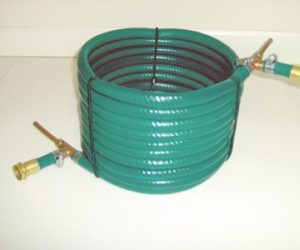
A derivative type of wort-maker is a HERMS, which stands for heat exchanged recirculated mash system. In a HERMS, the electric heating element is replaced by a heat exchanger — most often a copper coil  wort chiller submerged in a hot water bath. The idea behind a HERMS is that the electric heating element in a RIMS could scorch the wort whereas this would be impossible in a HERMS-type heat exchanger. There are a lot of other acronyms out there — RHEMS, HEMan, CHEM, HERMIT, etc. — that describe different variations on this theme. But all share the basic idea of recirculating and heating the wort to control mash temperatures.  

There is a lot of information available on RIMS and HERMS and much of it comes from RIMS/HERMS users who are justifiably proud of their machines. However, a wide variety of claims have been made about the benefits of RIMS brewing, but few of these have been demonstrated conclusively. On the other hand, there are some “RIMS doubters” out there who claim there are significant downsides to RIMS and HERMS wort-makers. In this article, I’ll attempt to take an objective look at the pros and cons of RIMS and HERMS wort-making. But before we can examine the pluses and minuses, we need to take a closer look at the equipment.

RIMS/HERMS Anatomy

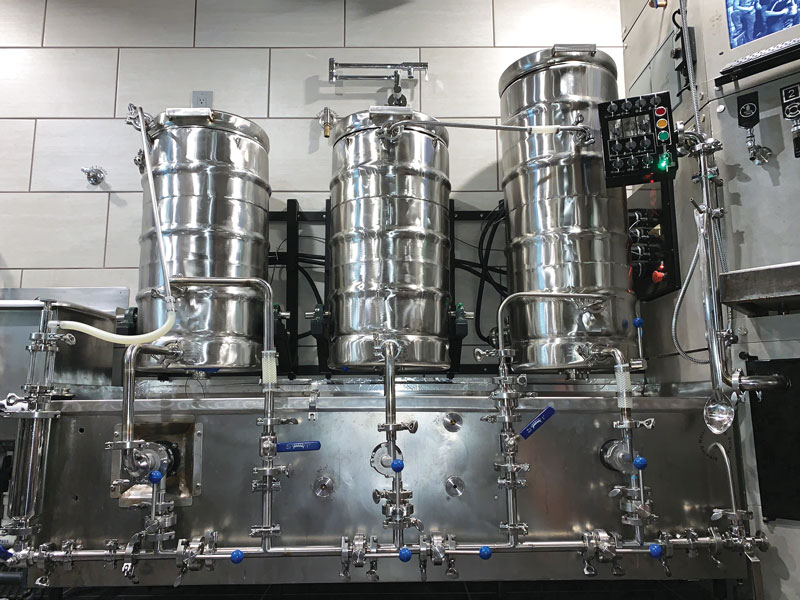
RIMS/HERMS set-ups are 3-vessel systems, usually attached to a stand, frame or cart. Most are designed to make between 5- and 15-gallon (19- and 57-L) batches, with 10 gallons (38 L) being a popular size. The system may be 3-tiered, 2-tiered or all on one level.

Hot Liquor Tank (HLT)

The first vessel in a RIMS/HERMS is the hot liquor tank (HLT), where water
is heated for the mash. It is usually a large pot or converted keg. In a HERMS, the HLT usually serves as the hot water bath for the heat exchange coil. The
tank may have a stirrer to improve the heat exchange.

Mash/Lauter Tun

The second vessel in a RIMS/HERMS is a mash/lauter tun. It is usually either a pot or converted keg of the same size as the HLT. Less commonly, a picnic cooler — in the 40 to 60 quart (38-58 L) range — may be used. This is the vessel that the recirculating loop originates from. Wort exits the vessel and either goes directly
to a pump, or into a small, open vessel (called a grant), which drains into
the pump.  

Grant  

The grant is optional. It is just a small pot, usually holding about a gallon (3.8 L) of wort, with a drain and perhaps a false bottom. The grant ensures that the pump is only moving wort that drains freely from the grain bed. Without a grant, it is possible that the pump will start sucking on the mash if the flow rate slows, and this will compact the grain bed.

Pump  

The pump is the heart of a RIMS or HERMS. In many RIMS systems, the rate of recirculation is around a gallon (3.8 L) per minute. Faster flow rates mean less contact time with the heating element. However, the upper limit of speed is determined by the rate of wort flowing freely from the grain bed.

Bringin’ the Heat  

In a RIMS, the wort in the recirculation loop is heated by an electric heating element. The heating element is usually sealed within a copper pipe. For a 5–10-gallon (19–38-L) RIMS, a 1,500-watt element should suffice for a single infusion mash. For brewers wishing to perform step mashes, a 4,000-watt or greater element is required to ramp the temperature up at an adequate rate — around 2 °F (1.1 °C) per minute. Heating elements should be of the “low density” type. For elements of the same wattage, shorter lengths provide more concentrated heat. The lower heat density of longer elements is less likely to cause scorching.

In a HERMS, the wort in the loop is heated by a heat exchanger, usually between 15 and 30 feet (4.5 and 9.1 m) of 1/2-inch copper tubing.

Wort Return

Once the wort has flowed past the heating element or heat exchanger, it is returned to the top of the grain bed. The wort return works in a manner similar to that of a sparge arm, except that the wort is returned to the mash below the liquid level, to minimize the possibility of hot side aeration (HSA).

Complete Control

Most RIMS brewers use a PID controller to automatically control their mash temperature. A temperature probe reads the temperature of the mash and relays it to the PID controller. The controller then calculates how much power should be fed to the heating element. (For much more on this, see Marlon Lang’s article, “Brewing on Autopilot” in the November 2003 issue of BYO.)

In a HERMS, the temperature of the water bath is constant. To achieve control over wort heating in the recirculation loop, a switch controls whether wort is routed through the copper coil or diverted past it.

The ultimate level of control in a RIMS or HERMS is a computer-controller that allows for programmed step mashing. If the pump is the heart of the system, this would be the brains. Using a computer, the brewer can input the length of various rests and then let his equipment do all the work.

Downstream stuff

The third vessel in a RIMS or HERMS is the kettle. From this point onward, the brewday is the same as any other.

Now that we’re acquainted with the elements of a RIMS or HERMS, let’s take a look at the claims made on behalf of these systems and the criticisms they have received.

The Pros of RIMS and HERMS

Perhaps the coolest benefit of a fully-automated RIMS or HERMS is the ability to do a programmed step mash. You can just input your mash profile, start your pump and let your system do the rest. Once the mash is finished, just redirect the recirculating wort from the wort return to the kettle. Very cool.

Rock Steady Mash Temperatures

With a RIMS or HERMS, it is possible to hold your mash temperature very steady. If you mash in a cooler or insulated pot or keggle with a false bottom, your temperature will drop at least 3 °F (1.7 °C) in an hour. If you mash in your kettle and heat and stir the mash occasionally, it’s not too hard to keep the temperature within 2 °F (1.1 °C); however, you will spend most of your time attending to the mash. In contrast, with no attention at all, a RIMS or HERMS can keep temperatures within 1 °F (0.6 °C), perhaps as close as 0.1 °F (0.06 °C).

But, what do rock-steady mash temperatures get you? One term that crops up all the time in RIMS/HERMS discussions with regards to mash temperatures is “repeatability.” The idea is that, since your mash temperature is well-controlled, your mash profile should come out the same (or very similar) every time. This sounds great, but is it true?

One thing to note in this regard is, although the temperature inside the mash/lauter tun remains steady, the wort goes through a “temperature rollercoaster” each time through the recirculation loop. The mash as whole may remain steady, during a mash, but little volumes of wort are constantly being heated and cooled by several degrees.

More importantly, although the claim of repeatability sounds logical, it has never been tested. Will a mash held to within 0.1 °F (0.06 °C) really yield more repeatable wort than one held within 2 °F (1.1 °C)? Is it really more repeatable than one that (repeatedly) drops 3 °F (1.6 °C) during every mash session? It would take a fairly involved experiment to prove this, and this experiment has not been done.

Also remember that mashing is a biological process. As with any biological process there is some variability that cannot be controlled.  It’s quite possible that the level of temperature control achieved in RIMS and HERMS mashing is swamped by the inherent variability in the biological system. It’s also quite possible that it isn’t — that’s why assertions need to be tested.

Clear Wort

If the mash is not stirred, the constant recirculation of the wort in a RIMS eventually yields crystal clear wort. This is almost always cited as a major benefit of brewing with a RIMS or HERMS. But why is super clear wort a benefit at this stage? Most articles or Websites discussing these systems are silent on this point. The claim that crystal clear wort is better wort is taken to be self-evident. I did find one site that claimed that part of the cloudiness in ordinary wort was due to lipids, and lipids in beer lead to premature staling (which it true). But does the crystal clear wort that comes from these systems really yield better beer than the slightly cloudy runoff common to most non-RIMS brewers? Like the claim of repeatability, this has never been tested.

Another question to consider is, does the recirculation of wort in a RIMS or HERMS clarify the wort too much? Studies have shown that a small amount of lipids carried over into the fermenter helps with yeast nutrition. You can argue the point either way — that’s why claims need to be tested.   

The Cons of RIMS and HERMS

One of the drawbacks of a RIMS is the potential to produce scorched wort. If the heating element gets too hot or the flow of wort past the element is too slow, wort can carmelize on the surface of the heating element. In a poorly-designed RIMS, this can be a real problem. However, in a RIMS with a suitable low-density heating element and adequate pump, wort scorching should not be an issue. And of course, in a HERMS, there is no possibility what-so-ever of wort scorching.

Ichabod Crane Beers

Some RIMS detractors claim that the slow speeds in RIMS step mashes produce thin, headless beers. A slow ramp through the protein rest temperature range will degrade foam positive proteins, they say. Likewise, a slow ramp through the alpha amylase range (140–145 °F/60–63 °C) will yield a very fermentable wort — which in turn will yield a very dry (or thin) beer.

If the heating element in a RIMS (or heat exchanger on a HERMS) is inadequate, there is the possibility of making a thin, headless beer. However, a properly-designed system will have sufficient heating capacity such that this is not a problem. Commercial breweries that perform step mashes have ramp speeds comparable to RIMS and HERMS, and their beers are not uniformly thin or headless.

Actual Cons

Although the most common criticisms of RIMS with regard to beer quality are not true, there are some practical drawbacks to RIMS and HERMS.

RIMS and HERMS take a quite a bit of space and are more expensive to buy or build than other all-grain systems. It’s a big jump from being a “bucket brewer” to brewing on one of these set-ups. But for many homebrewers, the extra investment in money and space is worth it. 
 
Buy or Build

If you’re thinking of becoming a RIMS or HERMS brewer, you have two options — buy or build. The advantage of buying a system is that you will get a tested design and have access to some tech support, should you need it. The downside is that they cost more.

The advantage of building your own RIMS or HERMS is much the same as the advantage of brewing your own beer — you can make it to your own specifications and tell people that you made it yourself. For those with the requisite skills, building a RIMS or HERMS can be a fun project. If you belong to a homebrewing club, there may be one or more members who have built their own systems. Inviting them over for a homebrew for your planning session and for key contruction steps would be well worth your while. The internet also has a vast amount of information from RIMS and HERMS enthusiasts, and you will likely get ideas for your system by taking a virtual tour of other set-ups.
 
Is RIMS/HERMS Better Than Regular All-grain Brewing?

RIMS and HERMS machines do perform as described by the folks who brew with them. They hold mash temperatures constant and produce clear pre-boil wort. The claims of how these affect beer quality and repeatability are untested, however. But the big question is — do RIMS and HERMS make better beer than “ordinary” all-grain methods?

This again would take a fairly large and detailed experiment to answer, but we can look to homebrewing contests for an idea as to how the experiment might go. If brewing on a RIMS or HERMS inevitably led to better beer, we would expect RIMS and HERMS users to hog all the medals. On the other hand, if RIMS and HERMS could only produce thin, headless beers, these brewers would be crying until their PID controllers short circuit after the medals are handed out.

In reality, neither group dominates at homebrew competitions. In the hands of a good homebrewer, a well-designed recirculating system can yield great beer. In less capable hands, it can result in a wort that goes round and round.

Chris Colby is Editor of Brew Your Own and writes “Techniques” in each issue. His ludicrously low-tech brewing system can be seen on page 42.


Subscribe

Free Trial Issue. Subscribe Today!

Send me a FREE TRIAL issue of Brew Your Own and start my risk-free subscription. If I like it, I'll pay just $28.00 for 7 more issues (8 in all) and save 30% off the annual newsstand rate. If I'm not completely satisfied with the trial issue, I'll just write "cancel" on the invoice and return it. I'll owe nothing and the trial issue is mine to keep.

Publisher's Guarantee: If you aren't completely satisfied with Brew Your Own Magazine at any time, for any reason, we'll issue a complete refund of your subscription price.

8 issues - $28.00 Add $5.00/year for Canadian postage Add $17.00/year for foreign postage

Risk-Free. Just fill out the form and click submit.

First Name
Last Name
Address
Address 2
City
State or Province
ZIP
Country
Email

This Free Trial Issue offer is only valid in the US and Canada. To subscribe to Brew Your Own outside the US and Canada, please click here.

To order a gift subscription to Brew Your Own, please click here.